
We were recently approached with a view to giving an interview for a digital printing podcast, about our journey from the traditional print industry, to digital.
Thanks to the Covid-19 situation, this was put on the back-burner along with just about everything else… but it gave us the inspiration to write this article about how things have changed for us within the past 48 years.
Please Note – any reference to lead times are a correct estimate at the time the article was published. Lead times are always estimated and never guaranteed, and for our current estimated lead times see: lead times & deadlines.
Back in the early 70’s, 1972 to be exact, a Mr. John Aspinall saw a gap in the market for a company to offer rotary print screen engraving services and colour separation services for the textiles and wallpaper printing industries.
Mr. Aspinall was already experienced and well connected within the printing industry, and Meshtex very quickly became established as one of the major players within the industry. The company quickly grew to over 60 staff, and we were servicing a very good percentage of the UK printing industry, supplying engraved rotary printing screens, and colour separation services.
The company is still going strong in 2022, although it’s fair to say that it hasn’t all been plain sailing, Meshtex has weathered numerous storms over the years, including a number of recessions and other events.
One of the biggest causes of continued downturn year by year for the entire industry within the UK, and in-turn for Meshtex, was overseas competition, with an increasing number of UK brands taking their business overseas in order to save money and increase margins.
While this threat to the UK print industry business was already very real, another potential threat to the traditional printing industry, was “digital fabric printing”, which is something that people in the industry began to talk about from the early 90’s.
We’re all very familiar with digital printing now, of course, but back then it was all very new.
We were aware of digital printers for printing onto paper, of course, but someone had found a way to get textile printing inks through inkjet print heads, and it was rumoured that digital textile printing would put most traditional printers out of business by the mid to late 90’s.
This didn’t happen, of course, and although digital textile printing continually went from strength to strength for small volume production and sampling purposes, digital printing had insignificant impact on the traditional printing industry until fairly recently.
One of the major reasons for this is that digital fabric printing has remained prohibitively expensive compared to traditional printing. Also, until quite recently, digital printing hasn’t been as reliable a process as digital printing, which saw print firms being reluctant to invest in digital printing as a way forward.
Meshtex invested in a Mimaki TX-1600 digital textile printer in the late 90’s, so we were one of the first in the industry to dip our toes into the digital market. However, digital printing didn’t become a major part of our business until more recently.
It was some time in 2017 that we saw that digital textile printing had, seemingly all of a sudden, become a major part of the UK print industry, and not just for small volume and sampling.
To begin with, we weren’t sure if we had left it too late to enter into the commercial digital textile printing industry, as although we’d been involved in digital fabric printing much earlier on, there were now several other companies already well established within this industry.
We did some research, however, and found that although there were many companies investing in what appeared to be a new and buoyant industry, there appeared to be a gap in the market which was perfect for Meshtex to become dominant.
This gap, was for a company with a wealth of real experience and skill within the textile printing industry, which we can convert into superior results for our customers.
Not only does Meshtex have nearly 50 years of experience in this industry, including key team members who have been with the company for multiple decades – Meshtex also has this same amount of experience of looking after our customers, and this is something that we feel we do better than most.
Also, we noticed that most digital fabric printing companies were generally offering either retail-focused web to print services, or high volume production aimed at much higher volume orders.
This meant that startups, smaller brands and designers wanting to create their own product ranges, were having to make the decision of either paying towards the retail end for their products, making it very difficult for them to make a margin, or to try to fight for the attention of much larger businesses who don’t appear too interested in taking their comparatively small orders.
So we created our digital textile printing service focusing on smaller brands and designers wishing to produce their own products.
We offer very low minimum order volumes, from just 5m of digitally printed fabrics, or from 20 manufactured products such as cushions, tea towels, aprons and tote bags.
We offer competitive trade pricing, on a sliding scale based on volume, and we allow our customers to mix designs and still benefit from the price breaks. For instance, if you’re ordering 10 each of 10 different designs, you’ll pay the 100 of price, not the 10 of price.
We also offer comparatively low lead-times. While some of the biggest volume producers may have lead times of several weeks and upwards, generally speaking our average lead-time for printed fabric is just 2-3 working days, and for manufactured products, just 4-5 weeks on average.

So we started out by investing in our first Mimaki TX300, making the decision to opt for pigment printing, due to several advantages this process has over reactive printing, for printing cottons and linens.
Reactive dyes are the other main popular process for digitally printing cottons and linens. Pigment printing is a cleaner process, without the need for steaming and washing, and pigment inks are water based, simply requiring fixing with heat after printing.
Pigment inks are on a parr with reactive printing for wash fastness and rub fastness, and pigment inks offer superior performance when it comes to UV fastness, which makes pigment printing the optimum choice for home furnishings.
One machine quickly proved not to be enough, however, and we doubled our production capability to digitally print cottons and linens, by installing a second Mimaki TX 300.
We began to see in increase in the range of polyester fabrics with real, practical end uses – such as high quality linen look fabrics with inherent FR properties, and 100% recycled fabrics diverting plastic bottles from our oceans, and as a result, we made the decision to invest in increasing our capacity in this area, with the investment of one of the new HP Stitch machines set up for dye sublimation transfer printing.

At the same time, in order to ensure perfect results, we invested in a brand new, state-of-the-art Transmatic rotary heat press.
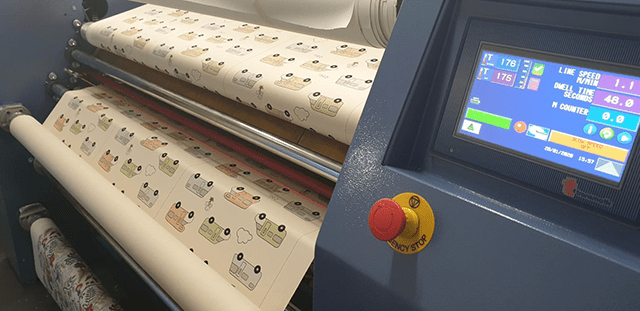
So as well as cotton and linen fabrics, we now offer a wide range of polyester fabrics on the roll and by the metre, including faux silks, other vegan alternative fabrics, stretch fabrics, linen look fabrics with inherent fire retardancy, upholstery fabrics, and the range continues to grow.
Wallpaper printing is another industry we have been involved in since our business began. Although the wallpaper industry is still dominated by the traditional methods, we saw a gap in the market for offering a high quality service for digitally printing wallpaper and wall murals, and a HP Latex wallpaper printing machine was installed. We now have a number of regular customers for whom we print both non-vinyl wallpapers on the roll, and also wall murals.
Now, in 2020, Meshtex are a digital textile and wallpaper printing company with a rich history in the traditional screen printing industry.
We still offer the same traditional rotary screen engraving and colour separation services that we did from the 70’s, albeit on an increasingly smaller scale.
While this may seem like a big change, really it’s just a change in output device, rather than a major re-direction in focus, which is, we feel, why we’ve been able to do so well within the digital arena in a relatively small time-frame.
In other words, we’re using our experience and skills to transform our customer’s art work from a file to a finished product, and this is what we’ve always done, the only difference has been a change in output method, along with a slight development of the business model, however it required little change to our core experience, skills and abilities as a company.
And then – coronavirus…
That knocked us backa bit temporarily, as we had to close for a month or so during the first lock-down.
We were soon back to work, though, and we’ve been able to continue going strong throughout the tiered lock-downs and the second national lockdown.
So just to be clear, we’re open as normal, and we’re very happy to hear from new customers.
So if you’re interested in our digital printing services, whether that may take the form of cottons, polyesters or linens on the roll or by the metre, fully manufactured printed textile products, or digitally printed wallpapers or wall murals, just email us.